Structure sets possibilities, not a finished outline
A mineral's crystal structure describes an ordered arrangement of atoms. Its outward habit describes the form you can see. These ideas are related but not interchangeable. The same mineral may grow as isolated crystals, tightly packed grains or radiating aggregates. A textbook drawing shows an ideal geometry; a natural specimen also records the space, chemistry and growth history available at its particular site.
When neighbouring crystals meet, they restrict one another's growth. A grain enclosed in a rock may never develop a complete external face. An open cavity can allow faces to develop more freely. This is why a glittering, well-shaped crystal and an inconspicuous grain can be the same mineral. Attractive faces are evidence of growth conditions, not a measure of scientific importance or value.
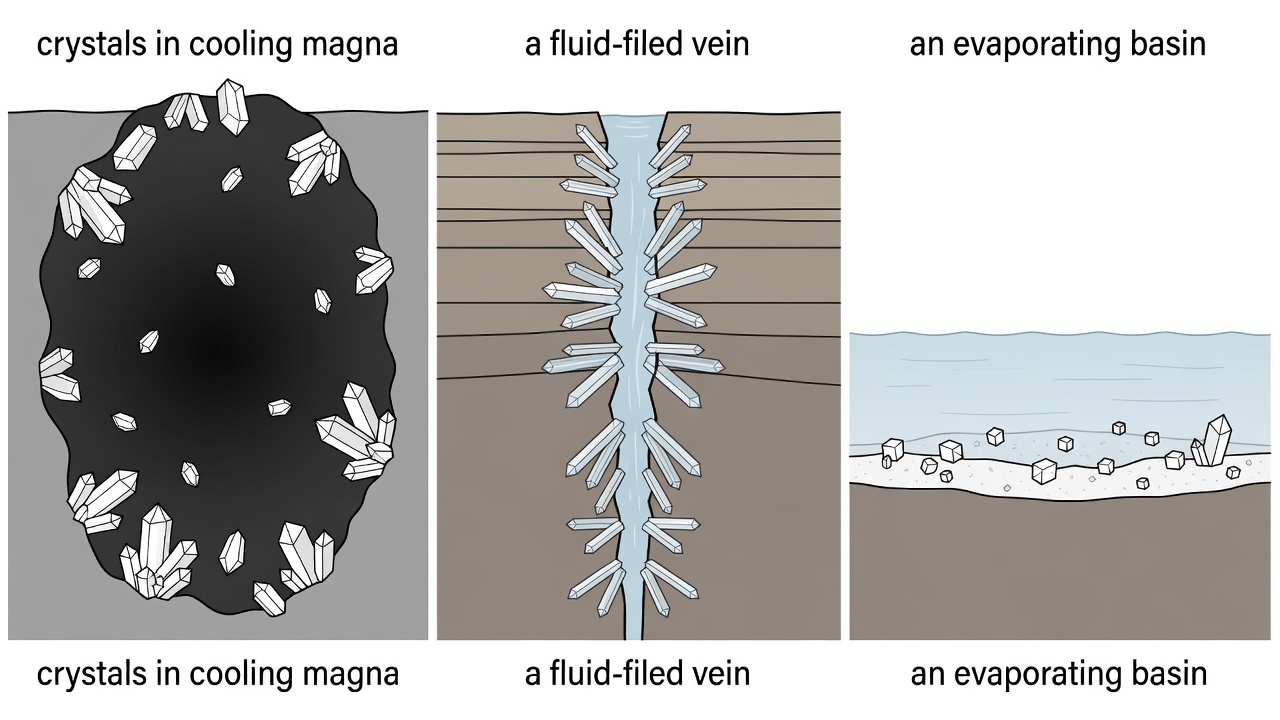
Three routes into a crystal
Cooling melts: competition inside a rock
As magma cools, minerals crystallise as conditions permit. Chemistry, pressure and the history of cooling influence the resulting assemblage. Granite commonly contains quartz and feldspars with other minerals. Especially coarse-grained pegmatites can develop where melt composition, volatile components and growth conditions favour large crystals; “slow cooling” alone is an incomplete explanation.
Mineral-bearing fluids: veins and cavities
Fluids moving through fractures can transport dissolved constituents. Changes in temperature, pressure, fluid chemistry or reactions with surrounding rock can promote precipitation. Repeated fluid episodes may produce layered fillings or successive mineral generations. A vein is therefore a record to investigate, not evidence that everything in it formed at once.
Evaporation: concentration changes
When water evaporates, dissolved constituents become more concentrated and minerals may precipitate. Halite and gypsum are familiar evaporite minerals. Which phase forms depends on solution chemistry and conditions; a white crust beside a drying pool is not identified simply by its setting or colour.
Unusual habits need ordinary questions
Needle-like crystals are called acicular; flattened crystals may be tabular; grape-like rounded surfaces are described as botryoidal. These words help communicate geometry without claiming a mineral name. Similar aggregate forms occur in different minerals. Fibrous-looking material requires particular caution because appearance alone cannot rule out an inhalation hazard. Leave unknown fibres undisturbed rather than pulling them apart for a closer view.
Twins are intergrowths with a specific crystallographic relationship. They are not simply any two crystals touching. Dendritic patterns can resemble branching plants while recording inorganic growth. Rounded or branching textures may reflect how material reached a growing surface, but a single hand specimen rarely establishes the complete mechanism. Describe the pattern first, then compare a proposed explanation with its geological setting.
- Habit
- Visible growth form
- Structure
- Atomic arrangement
- Texture
- Relationships between grains
Gemstone appearance has a geological history
“Gemstone” is a use category, not one geological origin. Ruby and sapphire are varieties of corundum; emerald is a variety of beryl. Their formation involves particular chemical conditions and geological settings, which vary between deposits. Colour may involve trace elements, defects or other mechanisms. A green transparent specimen is not established as emerald by matching an illustration.
Clarity and colour can also be affected by inclusions, fractures and treatments. Some internal features preserve information about the environment in which a crystal grew, while others formed later. Determining natural origin or treatment status is specialist gemmological work. This guide does not authenticate gems, distinguish every synthetic product or estimate market value. A documented laboratory report answers a different question from a beginner's habit description.
Look for evidence of a second chapter
A pseudomorph preserves the outward form of an earlier mineral after replacement or alteration. Its current shape can therefore point toward a former phase rather than identify the present composition. Weathering may coat crystals with oxides, dissolve edges or leave cavities. Fractures can fill with a younger mineral. These overprints explain why a specimen can contain apparently conflicting clues.
Ask which material cuts, coats or encloses which other material. Such relationships can suggest a relative sequence, though they need careful checking. Photograph the whole specimen before magnifying one attractive crystal. The surrounding matrix may hold the strongest evidence for how the assemblage formed. Preserve that context rather than trimming it away merely to create a tidier display.
Ground the story in a source
Compare your observations with descriptions of the actual locality or geological unit, when available. The British Geological Survey and the U.S. Geological Survey provide accessible starting points for rock-forming processes. Local geological maps, museum records and published deposit studies can add the detail that a generic crystal guide cannot supply. Keep a provisional formation story clearly labelled as provisional.
- British Geological Survey — geological maps, research and learning resources.
- U.S. Geological Survey — geological processes and mineral resources.
- Gemological Institute of America — gemstone research and educational resources.