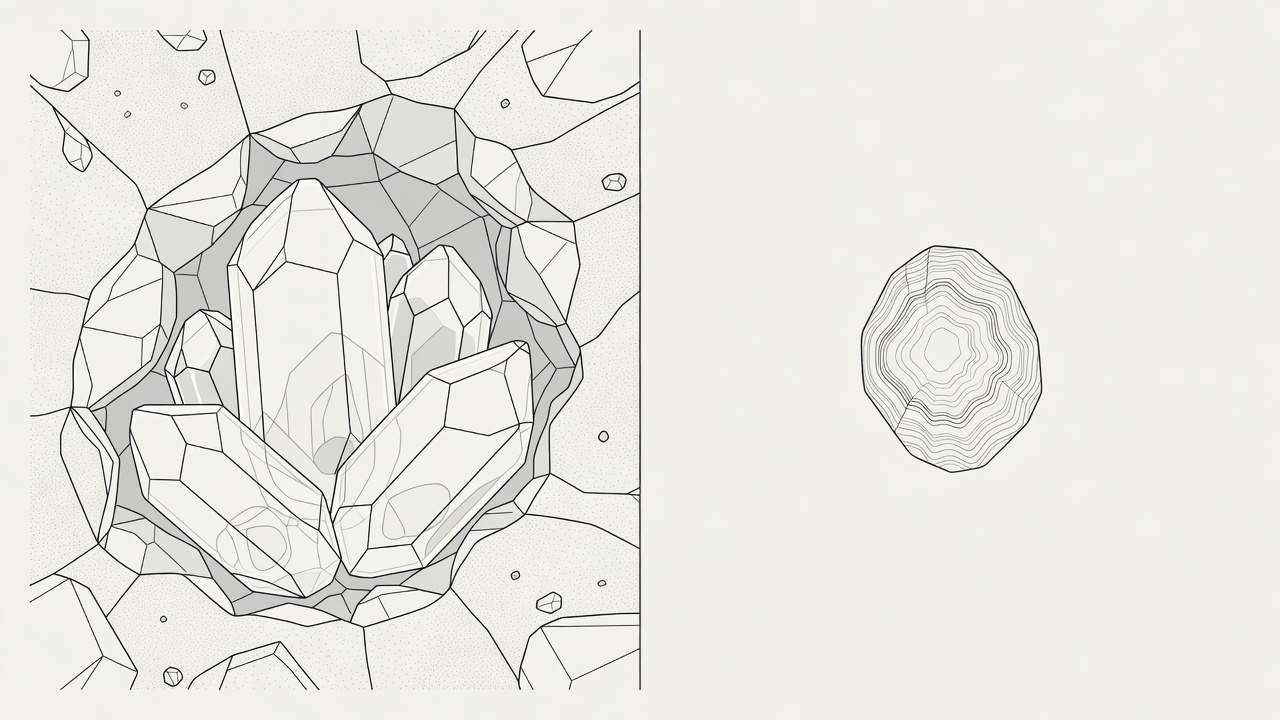
First ask what was actually discovered
“Discovery” can mean a newly recognised mineral species, a previously unknown occurrence, an unusual crystal population or a new result from an old specimen. These are different claims with different evidence requirements. A spectacular photograph may document appearance, while chemical analysis and crystallography address composition and structure. A publication's interpretation can also change as measurements improve.
Collectors should distinguish the locality where a specimen was recovered from the place where it formed. A mineral grain in sediment may have travelled far from its original rock. A museum specimen may become important decades after collection because a new analytical technique reveals information previously inaccessible. The field label and collection history can be as essential as the later instrument.
Naica: growth conditions written large
The Naica mine in Chihuahua, Mexico, is known for extraordinary gypsum crystals in underground cavities. Research on these crystals connects their growth to a water-filled environment maintained near particular thermal conditions over long periods. Their size is not explained by a vague claim that all caves simply grow crystals slowly. Chemistry, phase relationships and sustained environmental conditions belong in the explanation.
The setting is also a reminder that scientific interest does not imply visitor access. Underground heat, humidity and mine hazards are serious constraints. Naica is not a beginner collecting destination or an invitation to enter mine workings. For a collector reading about it, the useful transferable question is which environmental evidence supports a growth model, not how to find a similar-looking transparent crystal.
Jack Hills: an old story in a small grain
Zircon grains from the Jack Hills region of Western Australia include examples dated to roughly 4.4 billion years. These grains occur in younger sedimentary rocks and preserve information from much older source material. Their significance depends on analytical work, including uranium–lead geochronology and careful interpretation of internal domains. Their age cannot be determined from sparkle, colour or external shape.
A date on a zircon domain is not automatically the depositional age of the rock containing it. Researchers examine inherited cores, later changes and the reliability of measured systems. This distinction is valuable beyond ancient zircon: always ask what object or event a measurement actually dates. A strong conclusion states its target and limitations rather than attaching one dramatic number to an entire specimen.
Franklin and Sterling Hill: association matters
Franklin and Sterling Hill in New Jersey are celebrated for complex mineral assemblages, including fluorescent minerals. Their geological interest involves unusual chemistry, metamorphic history and a long record of study. Fluorescence is an emission response under suitable excitation; it is not the same as the ordinary reflected colour seen in daylight. Wavelength, impurities and specimen differences influence the response.
A glowing specimen is not identified by fluorescence alone. Compare composition-related properties, associations and locality documentation. Ultraviolet equipment also requires appropriate eye and skin precautions, particularly with shortwave sources. Museum interpretation offers a safer starting point than experimenting with unknown lamps. A locality's reputation does not authenticate a loose specimen bearing that name on an unverified label.
Larderello and Khatyrka: different kinds of novelty
Larderello, Tuscany, is associated with boron minerals and geothermal activity, illustrating how unusual chemical environments can produce distinctive assemblages. Its significance is not captured by a generic “rare crystal” description. Reading the geological setting explains why particular elements and fluids matter, and why a locality-specific account is more informative than a colour-based mineral list.
Khatyrka, in the Russian Far East, is linked to natural quasicrystalline material found in meteoritic samples. Quasicrystals have ordered structures without the translational periodicity of conventional crystals. Establishing that claim required specialist structural and compositional evidence, not an unusual outline visible to a hand lens. It is a useful example of a discovery whose importance lies in atomic organisation rather than display size.
Read beyond a headline
For any remarkable find, look for the named locality, the institution holding the material, the methods used and the distinction between results and interpretation. The International Mineralogical Association's Commission on New Minerals, Nomenclature and Classification provides the formal framework for recognising new mineral species. An unfamiliar trade name or a social media announcement is not equivalent to that process.
Do not turn scientific significance into an unsupported claim about commercial rarity, monetary value or healing. Supply, specimen quality, legal provenance and analytical identity are separate questions. A careful amateur can contribute by preserving honest records, reporting observations through appropriate channels and resisting the temptation to give uncertain material an extraordinary label.
Follow the research trail
- García-Ruiz and colleagues on Naica gypsum growth — a research account of the giant-crystal environment.
- Valley and colleagues on Hadean zircon — analytical evidence concerning ancient Jack Hills material.
- Franklin Mineral Museum — locality history and mineral interpretation.
- Sterling Hill Mining Museum — the New Jersey deposit and its mineral heritage.
- International Mineralogical Association — mineralogical organisations and nomenclature resources.
- Smithsonian Institution — mineral collections and research context.