Begin without changing anything
Place the specimen on a stable surface under good, neutral lighting. Record its size, visible colours, transparency and lustre. Turn it slowly rather than relying on one photograph. A glassy reflection, a metallic reflection and a dull weathered coating describe different observations, but none automatically supplies a name. Examine fresh-looking and altered areas separately; a coating may conceal the material beneath it.
Keep two columns in your notes: observation and interpretation. “Repeated flat surfaces meet at similar angles” is an observation. “Probably cleavage” is an interpretation. This separation makes it easier to revise a conclusion without losing the original evidence. If the specimen came with a label, copy the wording exactly before adding your own assessment.
Read habit and broken surfaces
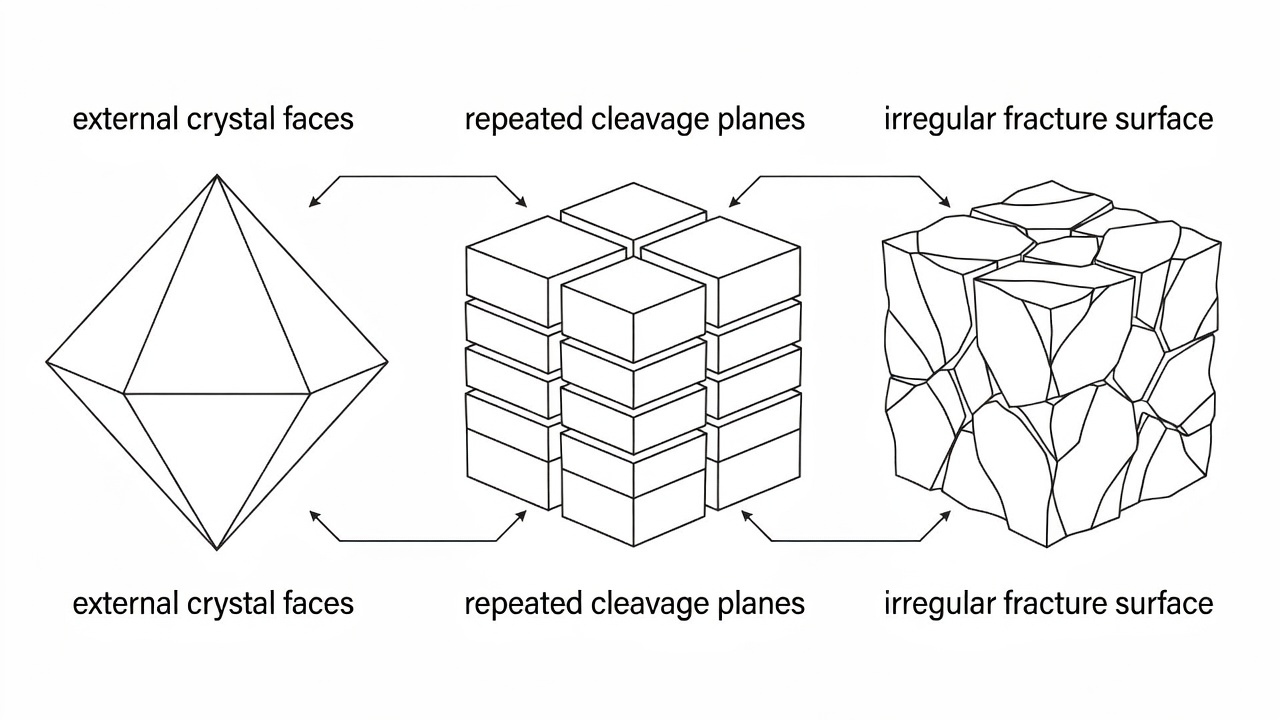
Habit describes the outward growth form of a crystal or aggregate: prismatic, tabular, fibrous, botryoidal and granular are useful examples. It is not the same as a crystal system. Crowded crystals may never develop complete faces, and broken crystals may retain only fragments of their original outline. Quartz commonly forms hexagonal prisms, but an incomplete prism is not enough to establish quartz.
Cleavage is a tendency to break along particular crystallographic planes. Fracture describes breaks that do not follow those planes. Calcite commonly shows rhombohedral cleavage; quartz lacks cleavage and often shows conchoidal fracture. Existing surfaces can suggest these differences. Do not deliberately break an unknown specimen simply to look for them, and do not mistake every shiny plane for cleavage.
Record the surface
Describe what is present: repeated parallel planes, curved breaks, striations or a weathered crust. Include scale and viewing conditions.
Ask what separates candidates
If two possible minerals share colour and lustre, look for a genuinely distinguishing property rather than collecting more examples of the same clue.
Keep an uncertainty statement
“Consistent with calcite; cleavage not confirmed” is more useful than an unsupported definitive label. A reference guide cannot authenticate your specimen.
Use hardness and streak cautiously
Mohs hardness is an ordinal comparison of scratch resistance, not a linear scale and not a measure of toughness. Talc defines 1, calcite 3, quartz 7 and diamond 10. A specimen that resists a known point but is scratched by a harder one falls within a comparison range. Weathered surfaces, mixed grains and loose powder can mislead you. A mark may be transferred material rather than a real scratch.
Streak is the colour of a mineral's powder, commonly assessed on unglazed porcelain. It differs from the colour of an intact specimen. Some minerals are harder than the plate and scratch it rather than yielding a useful streak. Both tests can damage material and create dust. Avoid them on unknown fibrous, friable or potentially hazardous specimens. Never taste a mineral or use household chemicals as an improvised identification routine.
- Hardness
- Scratch resistance
- Streak
- Powder colour
- Cleavage
- Preferred break planes
Bring the rock back into the question
A mineral does not arrive without a setting. Host rock, associated minerals and a reliable locality may make some possibilities more plausible than others. A pale crystal in a hydrothermal vein and a pale grain in a granite deserve different starting questions. Context supports an interpretation; it does not override conflicting physical evidence. A loose specimen purchased far from its source may have very uncertain provenance.
Use a reputable mineral reference such as the Mineralogical Society of America's educational material or the Natural History Museum's mineral collections resources. Compare the full property set, not just a search-result photograph. For genuinely difficult cases, optical methods, Raman spectroscopy or X-ray diffraction may be needed through a qualified institution or laboratory. A phone image cannot replace those measurements.
Finish with a testable label
Record the candidate name, supporting evidence, contradictory evidence and missing information. Distinguish an untested possibility from an identification supported by appropriate analysis. If a later observation disagrees, keep the earlier record and add a correction. That history is valuable: it shows how the conclusion changed and prevents a guess from silently becoming provenance.
Reference starting points
- Mineralogical Society of America — mineralogical education and publications.
- Natural History Museum, London — collections and Earth science resources.
- Mindat — locality and mineral records; check the evidence behind individual entries.